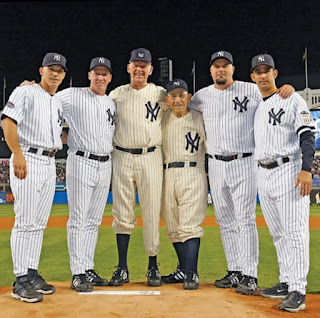
1941 New York Yankees
Good seasons are very common, and happen all the time for multiple players on just about every team...Great seasons are a bit more uncommon but it's not shocking to see entire all star teams comprised of guys having such types of seasons...Once-in-a-lifetime are as the name implies and the chances are rare that you get even one of those guys a season. So imagine the odds when two of those types of seasons happened in the same year.
Ted Williams of the Boston Red Sox was putting together a .400 BA season, to date the last time it has ever happened in baseball, meanwhile in the Bronx, Joe DiMaggio found a way to outshine him by putting together a record breaking hitting streak of 56 games. Each man would be far and away the obvious choice for MVP, but only one of them was getting the award in 1941. Not that either man was lacking in such recognition in their career (Williams would win 2 MVPs in his career, DiMaggio would win 3) but to take home the hardware in '41 would be the ultimate bragging right. Blame the fact that some writers didn't like Williams, or that fact that the Yankees finished better than the Red Sox in the standings, or the fact that hitting .400 was a marathon while the hitting streak captivated the minds and attention of the country, but when the votes were tallied it was DiMaggio with the recognition, 291 voting points compared to Teddy Ballgame's 254.
Besides personal glory, The Streak also inspired a slumping '41 Yankees and turned their season around, putting them in first place and allowing them to pull away from the competition, winning the pennant with a 101-53 record; 17 games better than 2nd place Boston. With the pennant, the Yankees and Manager Joe McCarthy returned to the World Series after their 4-straight title streak was snapped the year prior, and waiting to try to stop them this year was a new opponent that Yankee fans were going to get real familiar with in the coming decades: Brooklyn.
The World Series proved to be tight on the offense. After splitting 3-2 wins to open the series, the Yankees and Dodgers took a scoreless Game 3 into the 8th inning. DiMaggio, despite his legendary hitting streak, was contained to just a .263 BA in the series, but with 1 out, he singled in the games first run as the Yankees held on to win 2-1. The Dodgers had a chance to tie the series up in Game 4 as they took a 4-3 lead into the 9th inning. And after 2 quick outs, it looks like the Dodger's were on their way to the victory. Now the stage was set for one of the most infamous and crazy moments in WS history...
Tommy Henrich was hitting as Hugh Casey delivered a 3-2 pitch. Henrich swung and missed for the Strikeout. Game over, right? Nope, because Mickey Owen didn't catch it clean and the ball got away, allowing Henrich to break for 1st Base and keep the game alive. Up next, DiMaggio, who walked. Then up was Charlie Keller who was already 3-4 with an RBI in the game. Here, he delivers a Double that scored both Henrich and DiMaggio, putting the Yankees ahead and ruining the day for every Brooklyn fan. Bill Dickey walked next, then Joe Gordon added a 2-Run double of his own. The Yankees took a 7-4 lead, with all four 9th inning runs being unearned. The Dodgers went down 1-2-3 in the bottom of the 9th and instead of a 2-2 series, the Yankees were now a win away.
The Yankees took an early lead in Game 5, and after Tommy Henrich homered to make it 3-1, Tiny Bonham took control on the mound for the complete game victory, giving the Yankees their 9th title, and introducing the Dodgers franchise to the familiar feeling of failure that they would experience many, many more times against the Bronx Bombers.

The MVP wasn't *just* because of The Streak, as his 30 Home Runs and MLB best 125 RBI certainly helped contribute to the cause, not to mention leading his team to a pennant.