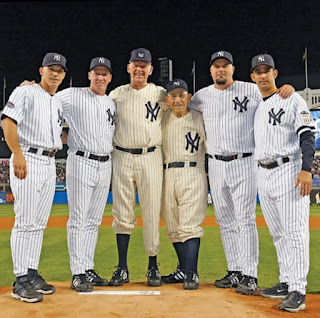
It was a combination of timing and my Yankee fandom that the first perfect game I ever witnessed was David Wells in 1998. Legend has it that David was out drinking all night before his start and rolled up to Yankee Stadium on the afternoon of May 17 hungover. Sober or not, he was absolutely dealing against the visiting Minnesota Twins as the Yankees cruised to a 4-0 win.
Wells needed 120 pitches to put the Twins down 27 straight, striking out 11 and only going to a 3-ball count four times. The game allowed the Yankees franchise to become the 2nd to have multiple perfect game pitchers, with Wells joining Don Larsen to match the Cleveland Naps/Indians perfect duo of Addie Joss and Len Barker. The tie would last barely over a year before the Yankees would break it with Davis Cone's own perfect game.
The perfect game was part of an unbelievable season for Wells, who would win 18 games that year, start the all star game for the American League and become the ace and #1 option for the Yankees in the postseason which saw them complete a record 125 win run for the championship. The craziest part of this was that even after pitching a perfect game, Wells didn't seem content.
Some pitchers have had magical seasons that saw them pitch multiple no-hitters, but while pitching a perfect game is a cut above and hard enough to do on it's own, Wells actually had the chance to not only pitch a 2nd perfect game, but to do it in the same season! On September 1, Well had pitched 6 perfect innings against the Oakland Athletics, but lost his bid in the 7th and ended up with only a mere 2 hit Shutout, thus ending the closest bid anyone has ever come to becoming immortal twice in the same season. Wells would have to settle for simply being the ace pitcher on the greatest team in modern history with just *one* perfect game to his name.
Boomer Wells brought the control and the innings needed to pull off a perfect feat. Helps that his chart is stingy with the advantage. And with a quarter of his rolls ending in Strikeouts, 11 seemed like a very plausible amount.
1998 was the year that Posada was officially taking the baton of starting Catcher duties for the Yankees. The man who groomed him to take over, teammate Joe Girardi, would get in on the perfect game action next season when he caught David Cone's perfecto.
The offensive star behind Wells was Bernie Williams. En route to his batting title in 1998, Williams scored 3 of the 4 Yankee runs. He bashed a Home Run and added a couple Doubles as LaTroy Hawkins had no answer to him.
It was another rough start for poor Hawkins on this day. He actually lasted 7 innings despite his card showing 6 and him giving up all 4 Yankee runs. Under Showdown rules that would limit his viable innings to just 5 and he'd have no extra control to shave down. He did manage a few 1-2-3 innings, so there's always the possibility of a strategy card being used to add an extra inning to his arm...
Speaking of things that don't align with the players card, Darryl Strawberry added to the offense by hitting an RBI Triple...with no such possibility existing on his card. Possibly more strategy cards involved. He scored the only Yankee run that Bernie Williams didn't.
That run scored by Strawberry came courtesy of Chad Curtis' RBI Single.
Wells made a lot of Twins hitters look foolish on that afternoon, striking out 11, but none more foolish than Javier Valentin. Javier got three shots at Wells, and all three times he was rung up for a K; twice looking and the final time in the 9th swinging. With that on-base, you can understand that Wells had the advantage each time to get those Strikeouts.
As mentioned in the
Tom Browning perfect game, Paul O'Neill holds the distinction of taking part in a record three different perfect games, all on the winning side. 1998 would be Paul's second perfect appearance, and he had the distinction of catching the final out to seal the deal for Wells.